An intelligence-powered WMS that makes your warehouse easier to run, bill, and scale.
For 3PLs, prep centers, and fulfillment warehouses that need to reduce employee confusion, capture every billable event, and give clients the kind of operational intelligence other warehouse systems leave out.
- Floor confusion
- −60%
- Billing capture
- Real-time
- On-time rate
- SLA-aware
Guided workflows
Reduce employee thinking, mistakes, and process confusion.
Billing automation
Capture receiving, storage, prep, handling, returns, accessorials, and outbound activity.
Client OMS included
Give your clients better visibility, auditing, support, and performance insights.
Touch-device friendly
Built for tablets, kiosks, scanners, mobile devices, and warehouse-floor execution.
Instant benefit presentation
See how your warehouse can double throughput and revenue in 12 months.
Watch the instant benefit presentation and see how the supply-chain effect turns isolated warehouses into a stronger fulfillment network.
The problem
Most WMS platforms record problems. UnieWMS helps solve them.
Warehouse operators do not need another system that only stores data. They need a system that helps the floor move correctly, helps employees know what to do next, helps managers see what is falling behind, helps billing capture the work being performed, and helps clients stop asking the same questions every day.
Most warehouse problems are not caused by lack of effort. They are caused by too much manual thinking across too many disconnected steps.
Employees guess too much
Every receiving rule, putaway decision, client requirement, carrier preference, prep instruction, and exception path cannot live inside an employee’s head.
Billing gets missed
Warehouses perform billable work every day that never gets properly captured, reviewed, or charged.
Clients need too much support
When clients cannot see what is happening, your team becomes the help desk for every order, inventory issue, delay, and invoice question.
Managers chase work manually
Supervisors spend too much time checking status, assigning tasks, correcting mistakes, and answering the same operational questions.
Systems do not talk
Orders, inventory, carriers, billing, marketplaces, and client communication often sit in different tools with no intelligence connecting them.
UnieWMS was built to reduce that friction.
Manager dashboard. Kiosk floor screen. One system.
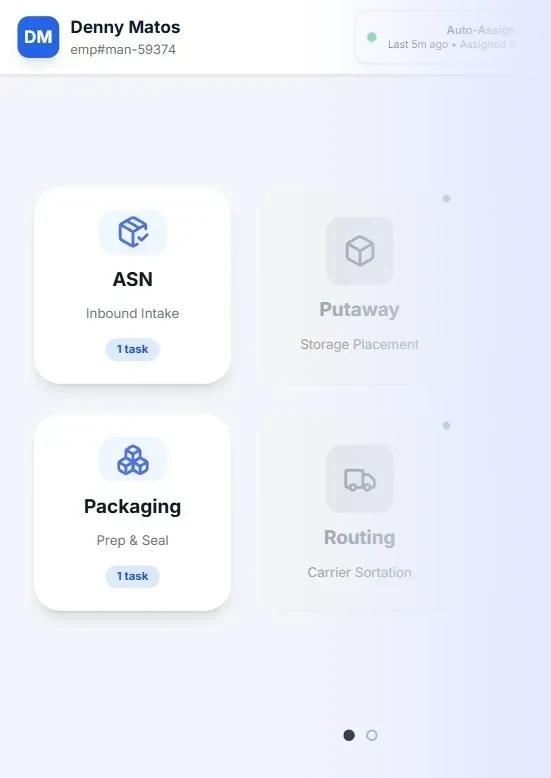
The supervisor in the office and the operator at the dock see different views of the same live state. One pane of glass for managers — receiving, picking, billing, exceptions. A kiosk-grade execution flow for the floor — large buttons, validated scans, no scrolling through irrelevant data.
Tablet, kiosk, scanner, mobile, workstation. Same data. Same decisions. Built for the floor, not the office chair.
.png&w=3840&q=75)
Automation
Automation-first warehouse management for the real floor.
UnieWMS is not built like a back-office database. It is built like an execution system for the warehouse floor. Employees work through guided steps. Managers see what needs attention. Billing events are captured as work happens. Clients get visibility without needing constant manual updates.
The goal is simple: make the warehouse easier to operate without forcing your team to think through every detail manually.
Touch-friendly execution
Large, clear, warehouse-ready screens for tablets, kiosks, scanners, mobile devices, and workstations.
Scan, confirm, complete
Workflows are designed around simple execution steps that reduce confusion and keep employees moving.
Less employee thinking
The system guides users through what to do next, where to move, what to scan, what to confirm, and when to escalate.
Faster training
New employees can become productive faster because the workflow carries more of the operational logic.
Fewer mistakes
Bad scans, missing confirmations, wrong locations, incomplete steps, and workflow errors can be flagged before they become client problems.
Manager visibility
Supervisors can see task status, exceptions, bottlenecks, and workload without walking the floor for every answer.
Watch a day
From dock to dispatch, guided.
Step 1
Inbound arrives
A trailer pulls into the dock. Instead of paperwork stacked on a clipboard, the receiving kiosk lights up with the expected ASN.
Reduce employee confusion by over 60% with guided workflows.
Most warehouse employees are forced to make too many decisions during the day. Where does this item go? Which order is urgent? Does this client require prep? Is this storage, cross-dock, return, or outbound? Is this service billable? Which carrier rule applies? Should this be escalated? Was the job completed correctly?
UnieWMS is designed to remove much of that thinking from the floor. The system guides the workflow, validates the action, captures the event, and moves the employee to the next step.
Your employees should execute the work. The system should carry the logic.
Manual workflow vs guided workflow
Same shift, same team, same orders. Different cognitive load.
Never run late again.
Orders and jobs do not stay in the order they arrived. UnieWMS continuously re-ranks pick lists, packing queues, putaway, and dispatch by the deadline that actually matters — carrier pickup, client cutoff, ship-by promise — and the work that puts those at risk moves to the top of the floor automatically.
Late carrier window? The system surfaces the affected orders before the cutoff is missed, not after. Slipping SLA? It re-orders the queue so your floor focuses on the work that prevents the breach — without your supervisor having to walk the floor counting minutes.
Deadline-first queue
Pick, pack, and dispatch lists re-sort whenever an order or pickup window changes.
SLA risk before, not after
Cortex flags at-risk orders against carrier cutoff times so they get worked first.
Manager visibility
Supervisors see the projected on-time rate live — not the post-mortem at end of shift.
Pick queue
Sorted by deadline · 4 active
Projected on-time
98.4%
ORD-30021
·ACME
Pickup 14:30 · UPS Ground
ORD-30055
·Zenith Co.
Pickup 15:15 · FedEx
ORD-30037
·Hatch Labs
Cutoff 16:00 · USPS Priority
ORD-30042
·Loop Goods
Cutoff 17:30 · DHL
At-risk
1
On track
3
Cutoff in
< 24m
Ghost inventory. Misleading reports. Caught before they hit a client.
The most expensive warehouse problem isn't the work — it's the data lying to you. Inventory that looks available but isn't. Cycle counts that disagree with the WMS. Reports that show clean numbers while the floor knows something is off. UnieWMS runs multi-layer validation across receiving, movement, cycle counts, and outbound to catch the drift before it ships.
Every metric the dashboard shows is reconciled against the events that produced it. When the numbers disagree, the system tells you which numbers — and why — instead of letting both sit on the screen as if they were the same truth.
Ghost inventory detection
SKUs that show available stock but consistently fail to pick — short-shipped, location-mismatched, or never actually received — surface as findings with the events that proved it.
Multi-layer validation
Receiving events, movement scans, cycle counts, and outbound dispatch cross-check against each other. Drift between any two layers becomes a flagged finding, not a hidden discrepancy.
Cycle-count reconciliation
Each cycle count is compared to the WMS view, the prior count, and the activity in between. The system tells you whether the count or the WMS is wrong — and what changed.
Report contradiction alerts
When two dashboards would tell different stories — e.g. on-hand vs. pickable, billed vs. captured — the system flags the contradiction instead of silently picking one.
Evidence trail
Every flagged finding links back to the events behind it. Disputes and audits become a paper trail, not a meeting.
Confidence per metric
Each metric carries a confidence score derived from how well its source events agree. Low-confidence numbers do not get the same weight as validated ones.
The point is simple: if your dashboard shows it, the floor should be able to back it up. If it can't, the system tells you before a client does.
Bill for the work your warehouse already performs.
Warehouse margin disappears when billing depends on memory, spreadsheets, manual notes, or end-of-month cleanup. UnieWMS connects operational activity to billing logic so your warehouse can capture the work being performed in real time.
Receiving, storage, pick and pack, prep, labeling, kitting, returns, special projects, accessorials, outbound handling, and client-specific services can all become structured, reviewable billing events.
If your team touched it, moved it, stored it, prepped it, labeled it, counted it, returned it, or shipped it — your system should help you bill for it.
Give your clients more than a portal. Give them a smarter operation.
Your clients do not just want to know where their inventory is. They want fewer mistakes, better visibility, cleaner billing, lower costs, faster answers, and confidence that their fulfillment partner is helping them grow.
UnieWMS connects with a world-class OMS and client portal designed to give your customers visibility into orders, inventory, activity, billing, marketplace movement, and operational performance. But the real value goes deeper. The OMS can help audit client activity on behalf of the warehouse, surface cost-saving opportunities, identify operational issues, and help keep clients performing at a higher level.
Fewer support tickets
Clients can see more of what is happening without asking your team for every update.
Better client auditing
The system can help identify issues, discrepancies, cost leaks, and performance opportunities across client activity.
Higher client satisfaction
When clients feel informed, supported, and optimized, the warehouse becomes harder to replace.
Stronger retention
A warehouse that helps clients save money and operate better is not just a vendor. It becomes an operational partner.
Better growth conversations
Instead of only talking about problems, your warehouse can show clients where their fulfillment, shipping, inventory, or marketplace activity can improve.
Help your warehouse grow by helping your clients spend less.
Most WMS platforms only help you manage inventory. UnieWMS helps your warehouse become more valuable to every client you serve. Through the connected OMS, billing intelligence, freight tools, and fulfillment visibility, your warehouse can help clients reduce shipping label costs, improve inventory placement, catch operational issues earlier, and understand where fulfillment is affecting their margins.
When your clients save money and perform better, they stay longer.
Lower client shipping costs
Help clients access better parcel, LTL, and FTL decisions through connected fulfillment and freight intelligence.
Improve client retention
Give clients visibility, audits, and cost-saving insights they cannot easily get from a basic warehouse portal.
Create growth conversations
Instead of only sending invoices, show clients where they are losing money and how your warehouse can help fix it.
Make your warehouse harder to replace
A warehouse that actively helps clients save money becomes more than a vendor. It becomes a growth partner.
Bring freight intelligence closer to warehouse execution.
Most warehouses treat WMS and freight as separate worlds. The warehouse picks, packs, and stages. Then rates, carriers, brokers, LTL, FTL, and delivery decisions happen somewhere else. UnieWMS is designed to bring those decisions closer together.
With UnieLogics connectivity, warehouses can access stronger LTL, FTL, parcel, and movement intelligence designed to reduce unnecessary overhead, improve routing decisions, and help operators understand the cost impact of how inventory moves.
Parcel awareness
Understand how fulfillment decisions affect shipping cost and delivery performance.
LTL & FTL intelligence
Access freight-connected logic that helps improve movement decisions beyond the warehouse floor.
Carrier decision support
Compare options more intelligently instead of relying only on disconnected portals or old habits.
Cost visibility
Help clients and operators understand where fulfillment and freight decisions are affecting margin.
Built to be easier to adopt — not harder to manage.
A WMS should not take forever to understand. UnieWMS is built around guided workflows, touch-friendly screens, and practical warehouse logic so teams can adopt the system faster and with less friction.
Implementation focuses on configuring the system around the way your warehouse actually operates.
The goal is not to install software. The goal is to make your warehouse easier to run.
Implementation includes
- ✓Warehouse workflow review
- ✓Location, zone, and bin setup
- ✓Receiving and putaway configuration
- ✓Pick, pack, dispatch, and return flows
- ✓Client account setup
- ✓Billing rules and rate cards
- ✓OMS/client portal configuration
- ✓Staff training
- ✓Go-live support
- ✓Network-readiness review for qualified warehouses
Flexible deployment for warehouses at different stages.
Some warehouses want to own and control the core WMS. Others want managed hosting, support, updates, OMS connectivity, and deeper UnieLogics intelligence. UnieWMS supports multiple paths without forcing every operator into the same model.
Option 1
Self-hosted core WMS
For operators who want control of the core warehouse system. Best for warehouses that want independent deployment of receiving, putaway, picking, packing, dispatch, inventory, billing, and client visibility.
Request review for this pathOption 2 (Recommended)
Managed UnieWMS
For warehouses that want hosting, updates, support, guided implementation, client OMS connectivity, and access to stronger operational intelligence. The recommended path for operators who want less technical overhead and more growth support.
Request review for this pathOption 3
Network operator program
For qualified warehouses that want to become part of the UnieLogics supply-chain network. Accepted facilities may be reviewed for cross-dock, overflow, holding, receiving, outbound, LTL, FTL, and other connected logistics opportunities.
Request review for this pathOnce your warehouse is easier to run, it becomes easier to connect.
The supply-chain industry is moving toward connected networks. Large operators are bundling warehousing, freight, technology, delivery, and client visibility under one umbrella. Independent warehouses need a way to compete without losing their identity.
UnieWMS gives your warehouse the internal foundation first: automation, billing, OMS, client visibility, guided workflows, and cleaner operations. From there, qualified warehouses can connect into the UnieLogics network — a system designed to create more direct relationships between warehouses, sellers, carriers, freight, and fulfillment activity.
The network opportunity should not replace your warehouse business. It should make your warehouse more valuable.
Today
Your warehouse, on its own
One facility, your clients, your billing, your team. Stable, but isolated from the broader supply chain.
Cross-dock
Support product that needs to move through your facility quickly.
Overflow
Use available space for qualified external demand.
Holding
Provide temporary storage for sellers, brands, or network activity.
Receiving
Support inbound activity for connected clients and partners.
Outbound
Handle pick, pack, prep, labeling, dispatch, and fulfillment work.
Freight-connected work
Participate in LTL and FTL-connected movement where your location and capacity create value.
Fix the warehouse first. Then connect it to something bigger.
UnieWMS helps warehouses solve the problems they feel every day: employee confusion, manual workflows, missed billing, client support pressure, disconnected systems, and poor visibility.
Then it gives qualified operators a path into something larger — a connected logistics network designed to reduce overhead, improve freight decisions, increase client satisfaction, and make independent warehouses more competitive.